
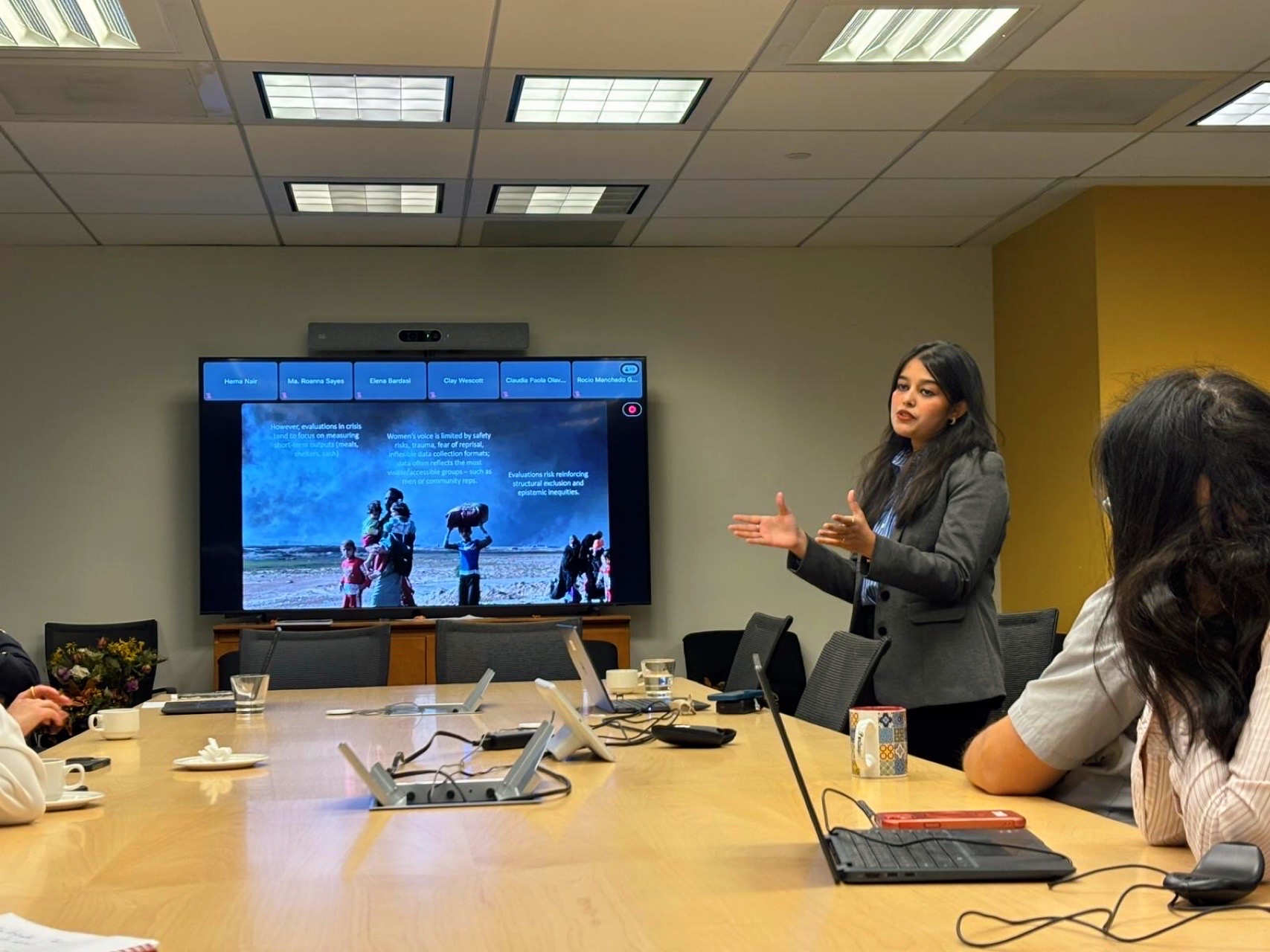
In 2025, I was one of six global recipients of the Global Evaluation Initiative’s Feminist Innovation in Monitoring and Evaluation Small Grant for Young and Emerging Evaluators. The award supported the development of a first-of-its-kind feminist evaluation toolkit designed to advance gender-transformative and feminist approaches in crisis settings. At its core, the project sought to reimagine how evaluations are conducted in emergency contexts – centring the voices and experiences of women, girls, and marginalised groups.
But the intellectual roots of this work were not born in 2025. They trace back to Oxford.
My academic journey at the University of Oxford – pursuing the MSc in Evidence-Based Social Intervention and Policy Evaluation – was made possible through the Weidenfeld-Hoffmann Scholarship. Building on my prior experience in policy evaluation, Oxford helped deepen and sharpen my analytical foundations. I still remember sitting in my study in New Delhi years later, designing the feminist evaluation toolkit. As I mapped frameworks and case studies, my thoughts kept returning to the Bodleian Library – the place where I refined enduring questions about what counts as evidence, whose voices are heard, and how evaluation can both reproduce and challenge inequality. That intellectual grounding, made possible by the Weidenfeld-Hoffmann Trust, became a key foundation for this toolkit.
Just as formative were my fellow WHT Scholars at Oxford. Our cohort brought together individuals from across the world, including Scholars from crisis-affected and fragile contexts. Their lived experiences of displacement, inequality, and resilience constantly disrupted abstract theorising. They reminded me that evaluation is never neutral – it is embedded in power, history, and lived reality. I say this with deep gratitude: these conversations shaped my worldview as much as any classroom learning, complementing and deepening my Oxford education. Whether during walks to libraries, over formal dinners in college halls, or over coffee on Little Clarendon Street, these exchanges shaped how I approached the project – ensuring it remained ethically grounded, contextually responsive, and rooted in lived experience.
As I developed the feminist evaluation toolkit, the influence of the Weidenfeld-Hoffmann Leadership Programme remained constant.
The Moral Philosophy seminars shaped how I think about evaluation itself. Hours spent grappling with questions of justice, liberty, and representation became more than academic reflection – they became a lens for interrogating evaluation practice. They pushed me to ask difficult questions: Who defines value in crisis contexts? How do we ensure evidence does not silence those most affected by crisis?
The Enterprise Challenge shifted this thinking into creation. It taught me how to move from ideas to structured outputs – how to think in terms of feasibility, iteration, and real-world usability. This mindset was instrumental in shaping the toolkit as a practical resource rather than a purely conceptual framework.
And so, this work travelled far beyond Oxford.
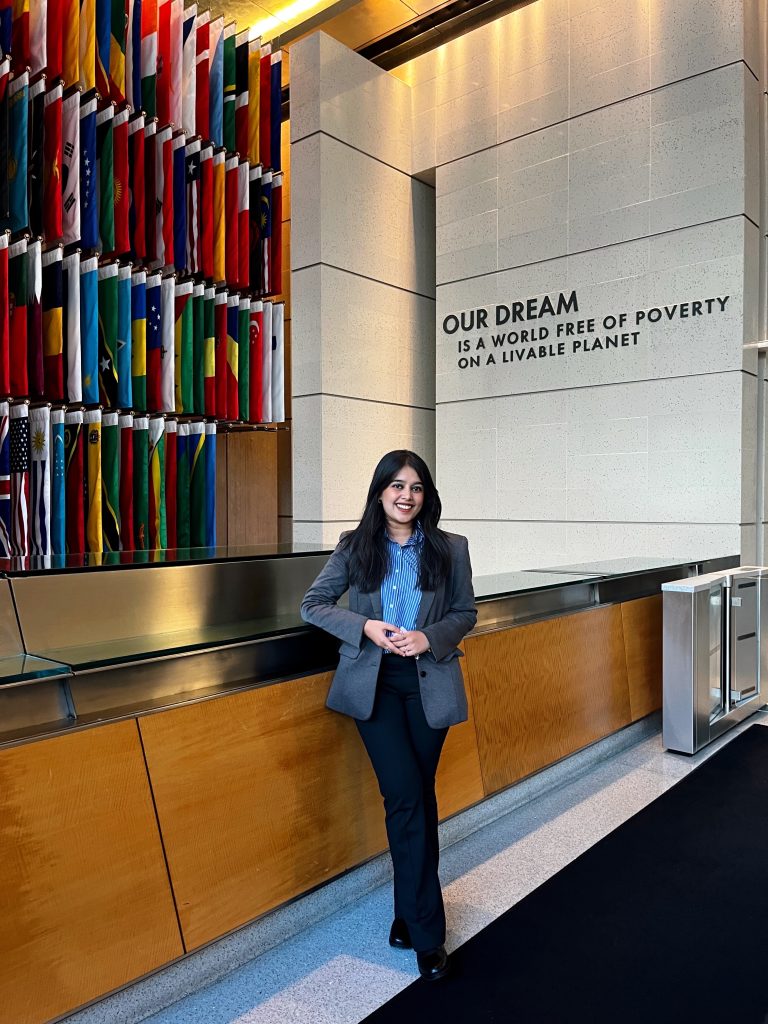
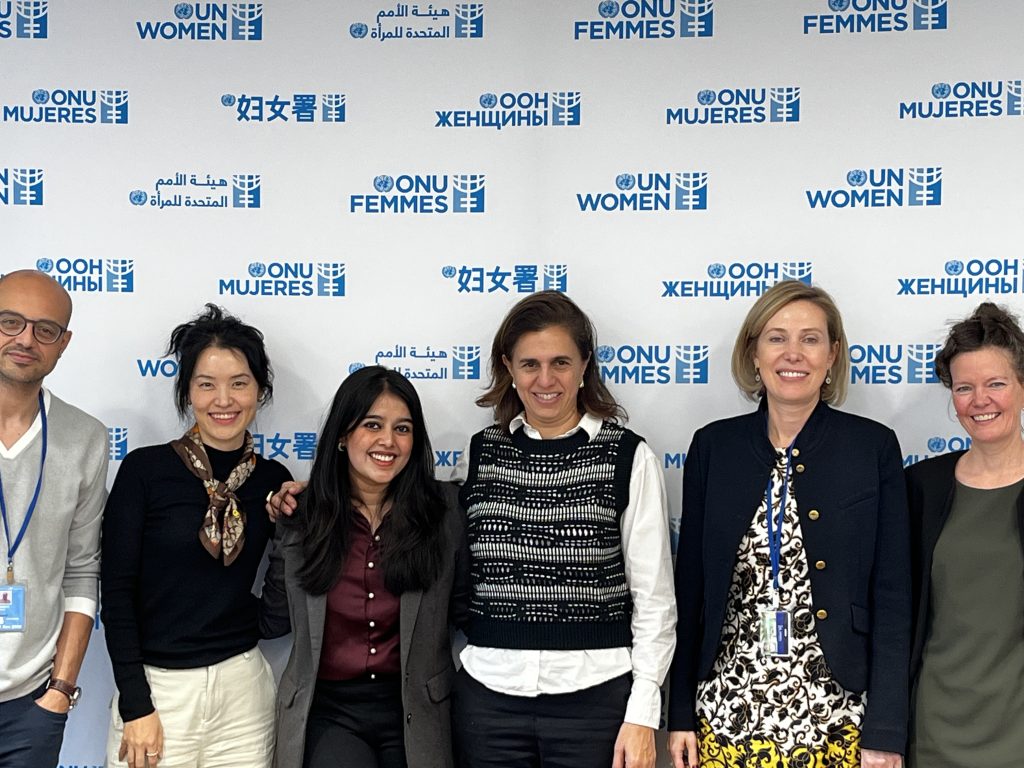
Last year, I found myself walking past the flags of the United Nations General Assembly in New York, presenting the toolkit at the UNICEF and UN Women headquarters. I navigated the corridors of the World Bank in Washington, DC, and later the bustling streets of Manila to present at the Asian Development Bank. In each of these spaces, I demonstrated how the toolkit can be used across the evaluation lifecycle in crisis contexts, anchored in a simple question: how do we ensure that the voices of women, girls, and marginalised communities shape what we define as evidence?
As I look ahead, I see the feminist evaluation toolkit as a living resource that can continue to evolve alongside the realities of crisis-affected communities – helping to ensure that evaluation practice stays accountable to those most often left at the margins. My hope is that it contributes, in small but meaningful ways, to a future where the experiences, voices, and agency of women, girls, and marginalised groups sit at the centre of how we understand and measure change.
That vision is deeply shaped by Oxford and made possible by the Weidenfeld-Hoffmann Scholarship.